
Hello everyone and welcome back to a brand new review! For this one I will be taking a look at the much anticipated third installment in one of the more influential horror franchises of the 2000s. When 28 Days Later came out in 2002 it was notable for a number of reasons as it furthered the prominence of Danny Boyle and Alex Garland as exciting creatives in the film space, furthered the star of Cillian Murphy, and reignited the zombie genre among other things. It was immensely acclaimed and ever since it and it’s sequel, 28 Weeks Later came out, the following for the series has only grown over time. I myself have always been vaguely aware of the franchise, without really knowing much beyond the basics. That being said, I thought the first trailer for this new film was so riveting a tease, that I was so excited for this in a stand a line sense and wanted to check out the others. I did catch up with them recently and I loved both of them quite a bit, with Days especially being one that I thought was exceptional. So now we have 28 Years Later which brings Boyle back in the director’s chair and Garland as a writer as they aim to tell a new story set in this world of the infected. Was it worth such a long wait? Let’s jump right in and see if this series has some more steam to last it another 28… whatever!
Things kick off with a haunting prologue as we witness a kid escape from his family who have gotten infected in the beginnings of the outbreak. 28 years later, the second outbreak that occurred, has now been contained to only the British isles with the rest of Europe having eradicated it. The area is now under quarantine with some individuals still trying to live their lives in this new normal. This includes one community in a tidal island known as Lindisfarne, which is connected to the rest of the area by one pathway that goes through the water. In this community, we follow a family consisted of a scavenger named Jamie, his sick wife, Isla, and their 12 year old son, Spike. Spike is about take an important ritual where he goes with his father to the mainland in order to hunt and kill infected. From there much goes down as Jamie learns more about this virus that has been prominent in the history he as known and he soon comes to wonder if there is anyway he can figure out what is going on with his ill mother.
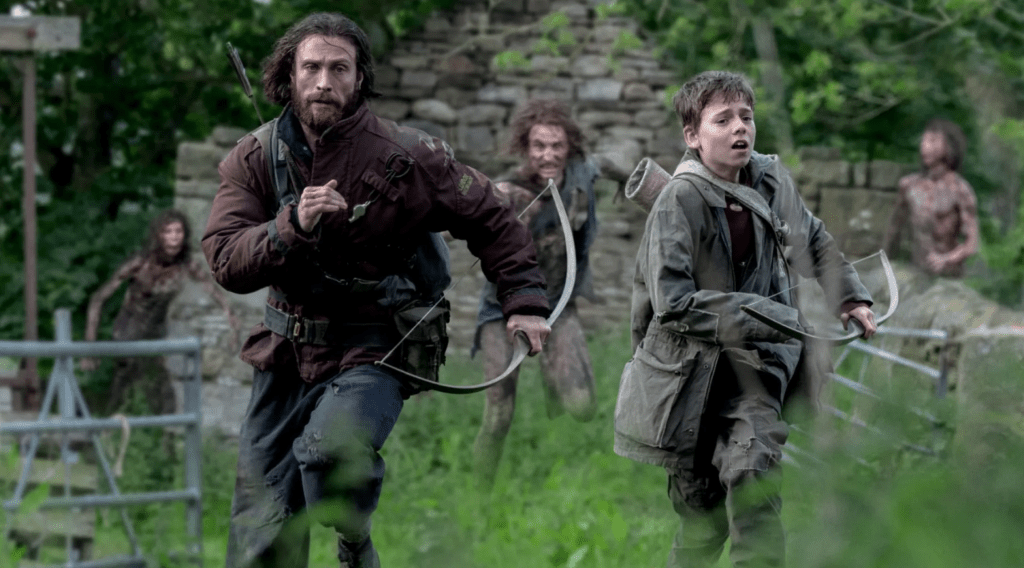
It is quite evident that Boyle and Garland are trying to make something that harkens back to the first film in how it meshes zombie mayhem with interesting conversations about life and what it means to live in what are essentially the end of times for these people. It not only succeeds at this greatly, but also manages to forge its own path and stand out from what came before. The first act excellently brings us back into this world, laying out the rules and livelihood of this community efficiently and also getting us into the shoes of a what it’s like to be a child in this sort of environment, being forced to grow up quickly and experience things no one should ever face with people who are more or less sanitized to these horrors. It’s a gripping ride as we get plenty of infected action and a sense of just how much the infected have evolved over the years becoming even stronger and more intelligent than before, which gives the chase scenes an extra layer of intensity considering we know what they are capable of. When we shift gears into the second act though, the film takes a bit of a different approach as Garland taps into some fascinating ideas and themes.
We get some more of the commentary on the flaws of humanity and how we may be worse than the Infected in certain ways (an idea very much explored in the original). The movie becomes a lot more ponderous and lyrical in a way that I wasn’t expecting. It’s like if the tone of the scenes in the first where our group was driving across the countryside was taken and made the focus of the latter half of this movie. It may come off as an odd shift for many, but for me I really loved what transpires with the film becoming something thoughtful and often times beautiful. The feature becomes this soulful mediation on death learning to accept it’s inevitability, but to not forget the life that once was present before it. There’s a strange sense of hopefulness to this grim tale as it argues that even in the end of times, empathy and one’s humanity are still important and will prevent one from becoming something worse. I found myself getting quite emotional during the climax with a specific sequence being one of the most powerful things I have seen in any form of media this year. It helps that everything is developed so well throughout the rest of the movie, so that that the emotional beats land harder than a jet plane hitting a runway. Also despite being a planned part one of a trilogy, the movie works on its own terms and promises an intriguing direction for the next part that makes me excited for what will transpire.

Among my favorite parts of 28 Days Later was how Boyle shot the film as it had this grainy look to it that almost made it seem like something we weren’t supposed to be watching and it enhanced the imagery of a deserted London even more. He goes for something similarly stylistic here, shooting portions of the film using various IPhone cameras in order to capture the action from different angles and it is very effective. The action has a visceral quality to it and it edited in a kinetic manner that never becomes nauseous or incoherent. It’s appropriately bloody and brutal, but in a way where one doesn’t feel happy or great when violence occurs given how it stops to show each target getting killed in enough detail to get across the horror of violence and death that Boyle and garland are going for. Another element added to these scenes is the the fact that infected are capable of more, which especially applies to whenever an Alpha comes into play. They are the strongest of the bunch and are able to do some truly insane things to the point where one came on screen, I was just nailed to the edge of my seat, wondering how our characters would escape this. There’s a nail biting scene set on the path in the water that really showcases this and for me encapsulates all of the great technical qualities of the feature.
As horrifying as a lot of the imagery is here (once again, kudos to the makeup team who worked on the infected as they look great as we get different subunits of them that all stand out), the film is absolutely stunning to look at. Excellent editing from Jon Harris, that often times serves to point out the thematic parallels to real life as we get between soldiers heading to war and what is transpiring in the film set brilliantly to Rudyard Kipling’s poem, “Boots”. Anthony Dod Mantle’s cinematography manages to combine beauty and terror into one with gorgeous shots of the British countryside that is brimming with colorful scenery, as well as some pretty disgusting and horrific elements present here such as dead bodies and blood often permeating the landscape. Does an excellent job on capturing what it must be like to live in this environment and the wide shots successfully emphasize the feeling of isolation that our characters must feel roaming this place. There’s a lot of interesting symbolism present throughout, with fire especially being a big one representing both life and death at the same time. That contrast of horror and beauty is present throughout the entire picture, especially when we reach the oddly calm third act that manages to present certain things that would normally be portrayed as appalling, as weirdly poetic. This mix also applies to the soundtrack courtesy of Young Father, which can range from the booming intensity present in the first two to soulful to bombastic… yet it all manages to work.

One of the neat things about this series is just how unexpectedly high profile the casts can be especially when for the first two films, a lot of the stars were just starting out (Cillian Murphy, Jeremy Renner, Rose Byrne, etc.). Here the cast is pretty recognizable from the get go, however we may have a new star on the rise in the form of Alfie Williams, who makes his acting debut as Spike. This is one of the best performances I’ve seen from a child actor in recent memory as Williams injects so much into the role, selling us on the character’s innocence as well as the trauma that he is facing from what transpires in the film, both related to facing the Infected and more personal reasons. Spike makes for a compelling lead as a child who comes to reject what society has taught him and come to his own path in a way that I thought was immensely satisfying. Williams is able to impressively hold his own against everyone else which is immensely impressive and I cannot wait to see what he does next as an actor. Everyone else is able to put in expectedly impressive work in different ways. Aaron Taylor-Johnson is great in a complicated role as Jamie, a father who is a product of his environment, being used to the violence and having no real awareness of his son’s true emotions and dilemmas and not exactly being a great husband as well, writing off whatever his wife says. That being said, he still does genuinely care for his family at the same time as flawed as he is and there are interesting layers to him that I hope get explored further in the next installment.
Jodie Comer is per usual, terrific as Isla, serving as the drive of Spike’s humanity and is the one aspect of his life that gives him genuine comfort. She is able to play up how Isla’s illness affects her from a mental standpoint, but also is able to maintain a lot of agency and play a critical part in the story. She gets some lovely bonding scenes with Williams and is able serve as the beating heart of the feature. I also quite enjoyed Edvin Ryding as Erik, Swedish soldier who ends up getting stranded on the island as he added some needed levity as a someone is a bit of an a**whole, but there’s more depth to him given as someone who realizes that this life and occupation may be isn’t as honorable as he thought. The real stand out for me though was the great Ralph Fiennes plays the mysterious Dr. Ian Kelson, a lonesome survivor who lives on the mainland and could hold the key to Isla’s illness. This is an excellent case of subverting expectations as I expected this character to be one thing, but he ends up not being that. He’s definitely on the kooky side, but also manages to be a man who has a profound appreciation for life and celebrates it in his own… some would say interesting way. He brings humor, intrigue, and a shocking amount of emotion to certain scenes that I wasn’t expecting and Fiennes excels in showcasing all of this. This is definitely a character that will likely have an even bigger role in the next film and I’m all for it.
On the whole, I found 28 Years Later to be a fantastic next step in this franchise and an exciting start to what has the potential to be one hell of a trilogy. It is immensely engrossing, is packed with intensity, hits hard on an emotional level, has a lot on its mind, is beautiful to look at, is exceptionally made, has incredible performances, and complex character work that shines. I think fans of the franchise will have plenty to admire here and I think if your looking for something interesting that subverts expectations, this is well worth a watch! It’s definitely not going to be for everyone, especially if one is going into this expecting a more conventional zombie flick. For me though, the beauty of it, is that it defies expectations and goes against the grain as it is all the better and more interesting for it. It is another winner in this, thus far, excellent series and I am honestly a bit surprised at just how much I dug it. Watching these films for the first time was quite the treat and I’m so happy that we won’t have to wait long to see what Nia DaCosta has cooking with 28 Years Later: The Bone Temple, set for this January. Bring it!
Rating: A+
Please leave your thoughts down below in the comments and see you guys later!
 Review Time